The colors that allude the most to the Christmas season are red, green and white colors. All these three colors are present in all four seasons, they only have different temperatures, values and intensities based on their season and subgroup of belonging. Today we’ll dive into the chromatic characteristics of the red colors which are the most difficult to identify.
Have you ever noticed that some red colors make you look washed out, overwhelmed or tired while others compliment your beauty? There is a reason for this, and it has to do with color theory. Each of us has specific chromatic characteristics just like all colors. If there is a temperature, intensity and value matching between you and the colors you use you’ll be valorized otherwise those colors will clash with your natural coloring.
Here is a guide on how to recognize and choose the most enhancing red color for you based on your color season and subgroup of belonging. Once you discover what is your best red you can use it in your clothing, make-up, nail aesthetics, jewelry, accessories and interior design as well if you would like to use your color palette also in your spaces.
THE RED COLOR TRANSLATED IN THE FOUR SEASONS
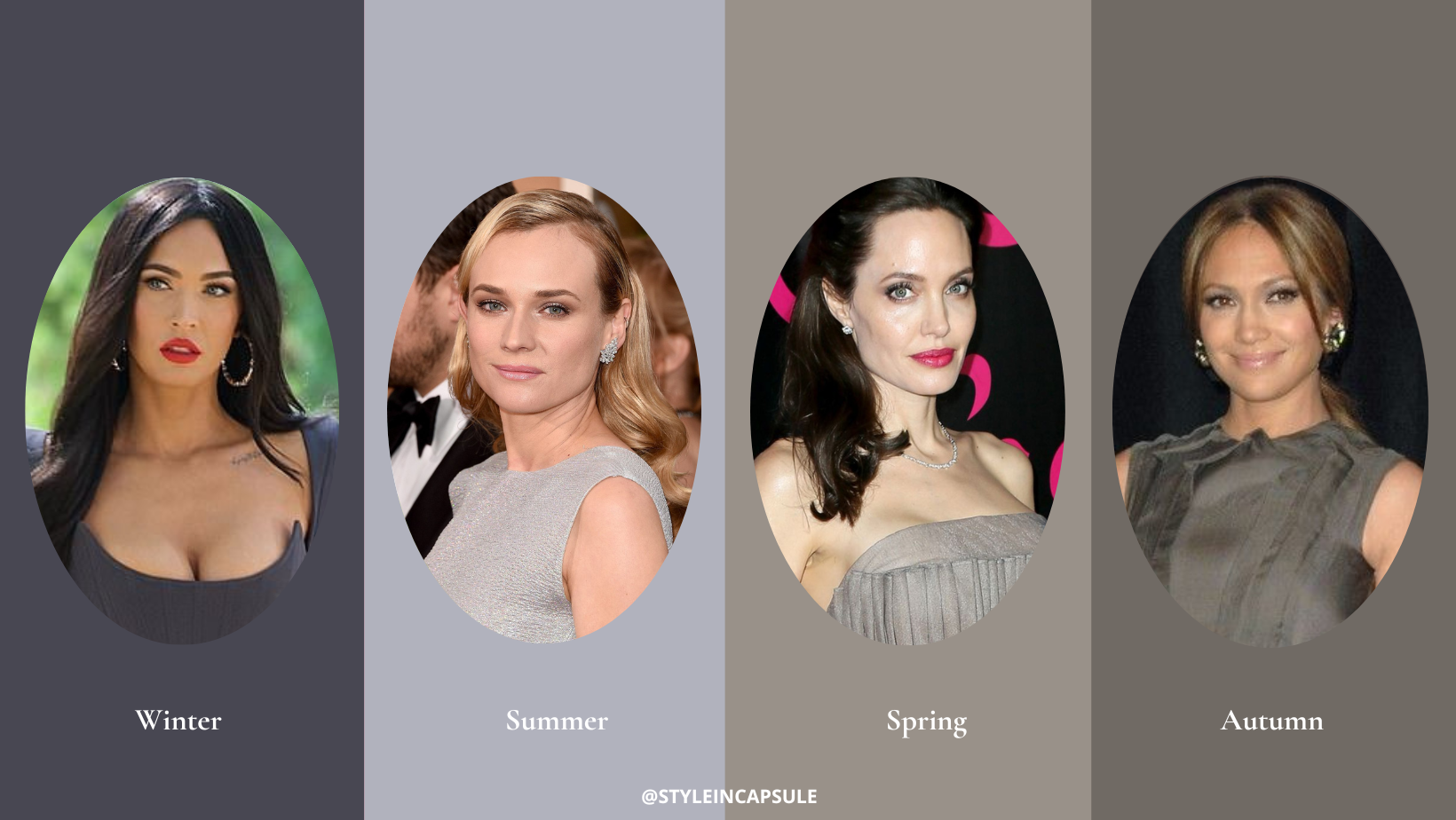
There are four original color seasons whose chromatic characteristics reflect the colors we find in nature in the four distinct seasons of Winter, Spring, Autumn and Summer. That’s why the red color in each season is different in temperature, value and intensity. All seasons have different chromatic characteristics but each of them has some feature in common with another season. The Winter and the Spring seasons are the ones with the highest intensity. The Summer and Autumn seasons have a low intensity. The Winter and the Summer seasons have a cool temperature, while the Spring and Autumn have a warm undertone. The Autumn and Winter seasons have a dark value, the Summer and the Spring season have a light value. The contrast is higher in the Winter and in Spring seasons, while it is lower in the Summer and Autumn seasons. These similarities between seasons allow the “flowing” of certain subgroups into others. We’ll see some examples in the following paragraphs and why they are important when it comes to choosing your best colors.
The chromatic variables of the red colors can vary for each subgroup of one specific season so they will be slightly brighter/softer, lighter/darker or warmer/colder based on the dominant aspect of the subgroup. There are so many shades of red in each season because there are four subgroups per season and because the individuals that are part of different subgroups of one season have the chromatic characteristics on different levels. The best red color for your coloring depends on your chromatic characteristics and dominant aspect (if you have one) present in your personal color palette (manifested in your hair color, skin complexion and eyes). You can have a dominant aspect only if you are not a “pure palette” individual which has the chromatic characteristics on the same level and that’s the reason it doesn’t have a dominant aspect.
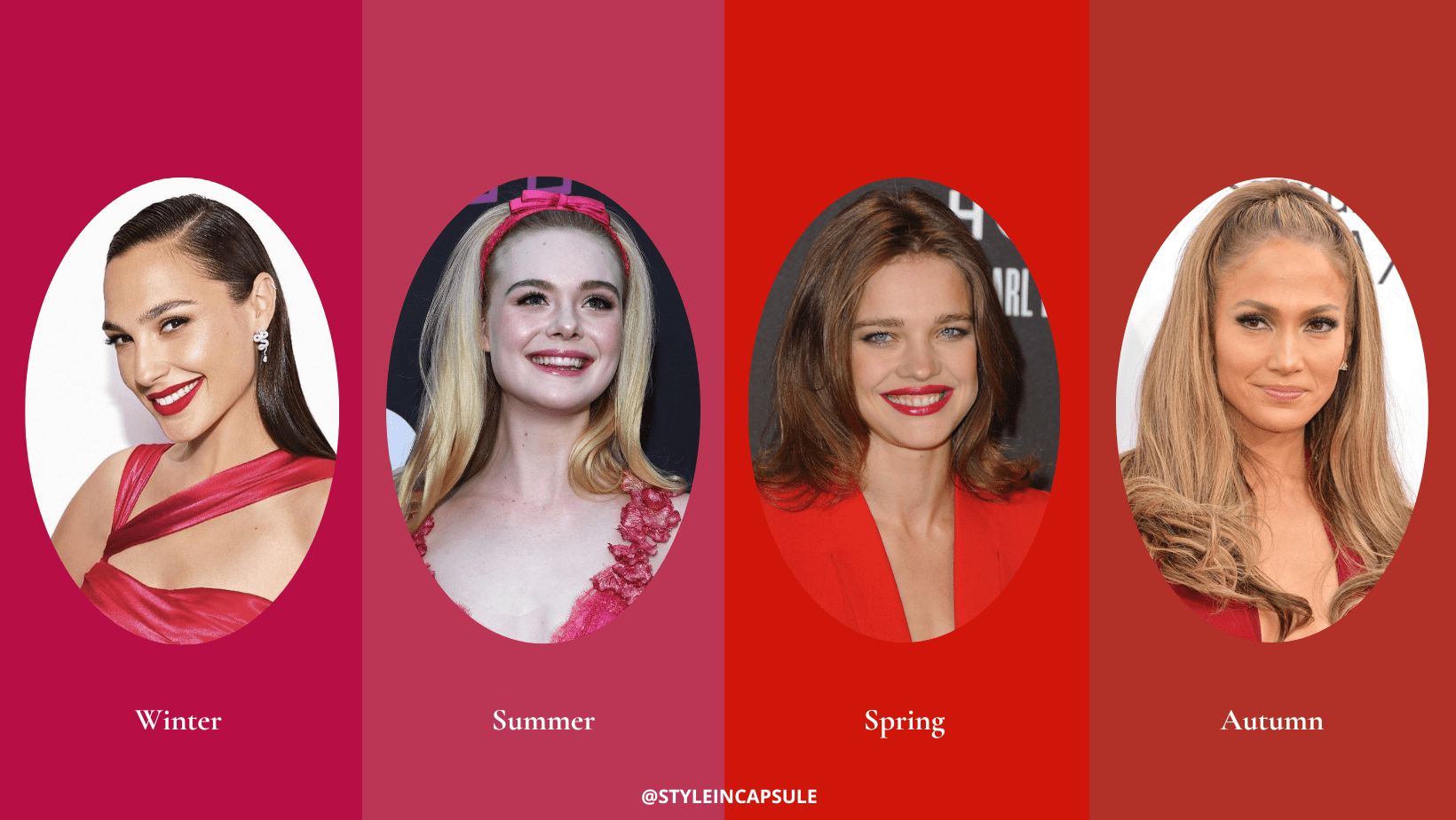
Here are four examples of red colors most reflective of each of the four seasons. We can say that Winter Reds are cool and brilliant like Ruby Red and Spring Reds are warm and vibrant and are referred to as Coral Reds. Summer Reds are Rosy Reds, delicate like Watermelon Red. Autumn Reds are warm and spicy like Paprika Red. The best way to start recognizing the palette of belonging of a certain red is to observe its temperature and intensity. The Winter and Summer Reds contain a certain amount of blue; that’s why they have a cool temperature. The Spring and the Autumn Reds contain a certain amount of yellow which makes them appear warm. The Winter and the Spring reds have bright intensity, while the Summer and Autumn reds have a soft intensity. At the beginning it can be very useful to have an illustration with a comparison of four reds of each season; in that way, you can immediately spot the difference in temperature and intensity.

WINTER REDS
The Winter Reds mimic the chromatic characteristics of the winter palette individuals, that’s why they bring out the most their natural coloring.

Gal Gadot – Picture from Pinterest

In the Winter Season, all red colors are cool, bright and deep but some are particularly “Bright” because they have the “Brightness” as a dominant aspect. Others are mostly “Deep” because the “Depth” is their dominant aspect and others are extremely “Cool” because their primary aspect is the “Coolness”. All colors just like all individuals can have a dominant aspect and this aspect of colors allows us to associate a red color to each subgroup. For example, the best red color for the “Winter Bright” subgroup will be the one with the highest intensity because this subgroup has the “Brightness” as a dominant aspect. The most valorizing red for the “Winter Deep” Subgroup will be the one with the darkest value because the low value will highlight the “Depth” naturally present in a “Winter Deep” palette person. The most enhancing red for the “Winter Cool” subgroup will be the one with the lowest intensity compared to the other winter subgroups because on the seasonal flow chart the “Winter Cool” flows into the “Summer Cool” and because it sits next to it, the intensity of a “Winter Cool” palette individual is lower than the other winter subgroups. The “Winter True” palette person instead suits well all the red colors from her/his palette because she/he doesn’t have a dominant aspect. Here is a guide to clarify the color theory and illustrate the best red colors for the winter palette person based on his/her subgroup of belonging.

SPRING REDS
The Spring Reds repeat the chromatic characteristics of the spring palette individuals, that’s why they are the most enhancing for them.
Natalia Vodianova – Picture from Pinterest

In the Spring Season the Red Colors are warm, light and bright. Here again, based on the subgroup of belonging and the dominant aspect of an individual, the most valorizing reds will be slightly lighter, warmer or brighter. If an individual is a “Spring Warm” the best red will be the one that emphasizes the dominant aspect of the individual – the “Warmth”. If a person is “Spring Bright” the most enhancing red will be the brightest one. The “Spring Light” individual will prefer the lightest warm coral red because it repeats the dominant aspect which is the “Lightness”. The “Spring True” instead will be valorized by all the red colors from the “Spring True” subgroup because it doesn’t have a dominant aspect.
Here is a guide to clarify the color theory and illustrate the best red colors for the spring palette person based on his/her subgroup of belonging.

SUMMER REDS
The Summer Reds are cool and delicate just like the coloring of the individuals that are part of this season.
Elle Fanning – Picture from Pinterest

As in the previous two seasons, we have to make a distinction between the subgroups to associate a red color that mimics their dominant aspect. The “Summer Soft” individual needs the softest reds to bring out her/his coloring. The “Summer Light” person needs the lightest reds to avoid overwhelming her/his delicate appearance. The “Summer Cool” individual has the highest intensity among the summer subgroups because it sits next to the “Winter Cool” subgroup on the seasonal flow chart, that’s why she/he can handle both the delicate reds of the summer season but also some winter reds from the “Winter Cool” subgroup which has the lowest intensity among the winter subgroups. The “Winter True” subgroup doesn’t have a dominant aspect; that means that all red colors from the “Winter True” subgroup will highlight its coloring. Here is a guide to clarify the color theory and illustrate the best red colors for the summer palette person based on his/her subgroup of belonging.

AUTUMN REDS
The Autumn reds are warm, soft and spicy and repeat the chromatic characteristics of the autumn palette individuals.
Jennifer Lopez – Picture from Pinterest

Also in this season the red colors will be slightly deeper, warmer or softer just like the individuals we can find in the autumn season. The “Autumn Deep” subgroup flows into the “Winter Deep” subgroup, that’s why it can handle autumn’s medium-soft red colors but also some winter colors like cherry red, because even if it has a medium-soft intensity it can tolerate also a higher intensity because of the winter influence only if the winter color has the “Depth” as a dominant aspect. The “Autumn Warm” subgroup sits next to the “Spring Warm” on the seasonal flow chart, that’s why even if its intensity is soft and suits the soft autumn reds with the “Warmth” as a dominant aspect, it can handle also some warm and bright red colors from the “Spring Warm” subgroup. The “Autumn Soft” subgroup has the lowest intensity among all the autumn subgroups because it flows into the “Summer Soft” subgroup. Because of the summer influence, the best red for this subgroup is a red that has as a dominant aspect the ”softness” just like the dominant aspect of the individuals that are part of this subgroup. The ”Autumn True” subgroup will be valorized by all the colors from the “Autumn True” palette because it doesn’t have a dominant aspect. Here is a guide to clarify the color theory and illustrate the best red colors for the autumn palette individual based on the subgroup of belonging.

CONCLUSION
It is not an error of course if you use a red color from another subgroup of your season of belonging, it will always enhance your coloring because the temperature of that specific subgroup will match yours. The difference is that your subgroup’s red will be more valorizing because it will highlight your dominant aspect, which if emphasized, will bring out your coloring the most.
Color analysis works by repetition. Once you know in which color season you belong and what is your subgroup, choose the red color that emphasizes mostly your dominant aspect which represents your subgroup of belonging. If you are a “true palette” person instead pick the red that best brings out your temperature, value and intensity.
Knowing your subgroup of belonging will allow you not just to highlight the most your natural beauty but also to find out what is your sister subgroup and what colors you can borrow from it which means adding more colors in your palette that valorize you.
Want to learn everything about the colors from your subgroup? Visit our shop where you can find a Pdf Color Guide for each of the sixteen subgroups that will teach you everything you should know about your natural chromatic characteristics and the colors from your subgroup to highlight your personal color palette.